You’ve Received a Behavior Alert About Your Child
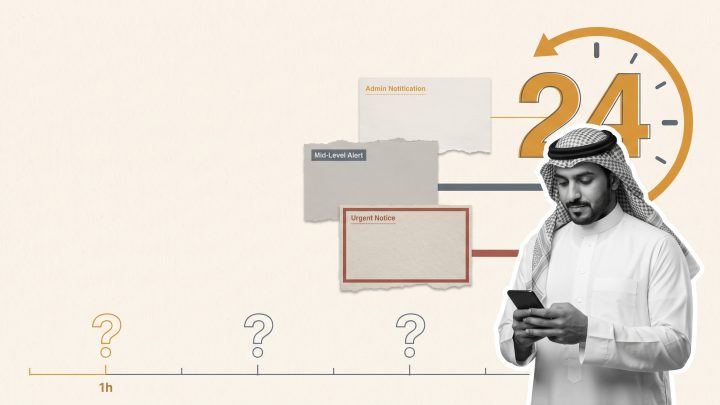
It’s twelve noon. The phone vibrates during a meeting, and you glance at it quickly: a notification from the school. One line, no more, containing a behavioral violation or a note or an entry. No context, no detail, no name of a person to call.
And the family begins its evening with a fight that could have been avoided.
This is a situation that recurs every year on a wide scale in our schools, and there is hardly a single piece of Arabic-language content telling a family what to do in the hours that follow.
First: What Is the Alert in the First Place
A behavior alert is an administrative record of an incident. It is not a judgment on your child’s character and not a report on his morals.
The Ministry of Education addresses school behavior within the Conduct and Attendance Rules, and violations vary in their degrees and in the procedures that follow from them. The difference between a family that treats the entry as information and a family that treats it as an accusation is the difference between solving the problem and inflating it.
And Not All Alerts Are the Same
Before you decide on your reaction, classify what you have received, because there are three types and they differ entirely in how they are handled.
The first is an attendance alert: lateness, absence, or leaving a class. This is usually a matter of time management, sleep, and routine, and its remedy lies at home more than at school.
The second is a passing behavior alert: an argument, a raised voice, a breach of the regulations. This is a single incident handled with a conversation and a repair, and it calls for nothing more.
The third is an alert that touches another person: harm, bullying, or damage to property. This one alone calls for a full course of action — listening, a specific repair, and follow-up with the school.
Confusing the three is the primary cause of responses that are exaggerated, or more lenient than they should be.
The Four Mistakes of That Same Evening
The first is confronting him the moment he walks in the door. Your child is coming back from a long day, he usually knows the notification arrived, and he is ready to defend himself rather than to talk. Wait an hour.
The second is judging before listening. The alert necessarily carries one side’s account, which does not mean it is wrong; it means it is incomplete.
The third is the angry call to the school, which turns the student counselor from a potential ally into a party defending himself, and so you lose the most important source of information you have.
The fourth is the maximum punishment on the spot. Taking the device away for a month ends the discussion and teaches one lesson: not to get caught next time.
Three Questions for the School Before You Ask Your Child
Call the student counselor or message him calmly and ask: what exactly happened, when, and who was present? Is this the first time or is there a history that did not reach me? And what is the proposed plan for the next four weeks?
The second question is the most important, because a single incident is one thing and a recurring pattern is something else entirely. As for the third question, it moves you from the position of the one being held to account to the position of a partner.
How to Open the Conversation With Him
Start with a sentence that describes rather than accuses: I got a notification from the school, and I want to hear the story from you.
Then be silent. Silence here is a tool, not an awkwardness, and what most spoils these conversations is a parent filling the gap with one question after another, turning the exchange into an interrogation.
And when he talks, pay attention to an essential difference: is he telling you what happened, or telling you who is to blame? The student who begins with the other one having started it has not yet reached the stage where he can repair anything. And this is not treated with pressure, but with one question after he has calmed down: if you could go back to that moment, what is the one thing you would have done differently?
“The Teacher Is Targeting Me”
A sentence many students say at this age. It is sometimes true and sometimes a defensive shield. The mistake is to settle it on the spot in either direction: believing it entirely puts your child in a confrontation with his school, and disbelieving it entirely teaches him that you will not believe him the day he is genuinely wronged.
The balanced answer: maybe, let’s look into it. Then ask him for something specific — that over two weeks he records what exactly happened each time: the date, the situation, and who was present.
The request in itself does two things: it gives him the sense that you are with him, and it turns a general complaint into facts that can be discussed. And in most cases the page reveals the pattern itself, whether it lies in the teacher’s conduct or in your child’s.
When the Alert Is a Symptom Rather Than a Behavior
This is the most important section of all the above.
A repeated alert, especially if it is concentrated in particular classes, or at particular times of day, or accompanied by a decline in schoolwork, may not be about discipline at all. Behind many repeated alerts lies an undiagnosed learning difficulty, since the student who does not understand the lesson disrupts it. Or inattention that shows up as behavior and is read as indifference. Or bullying he is subjected to, so that his response gets recorded while the origin of the situation does not. Or pressure at home that comes out at school.
This connects directly to what the General Education Law stipulates in its Article Nineteen regarding programs for the early detection of disorders. If the alerts recur, the right question to the school is not: how do we punish him? It is: has any consideration been given to the possibility that there is another cause behind this behavior?
And If You See an Injustice in the Entry
A student has a statutory right to have his complaint heard, registered, and acted upon, under the text of Article Thirty-Eight of the Law. The correct route is submitting the complaint and having it formally registered, not managing it through a passing conversation or through the parents’ group.
The Following Two Weeks
Agree with your child on one specific alternative behavior rather than on a list: if someone provokes you, leave the situation and talk to the teacher. And set up a short weekly check-in with the school for a month.
Then tell him when he improves, a step that is always forgotten. The student who is noticed only when he does something wrong learns that being noticed comes only through doing something wrong.
A behavior alert is not the end of anything. It is information that reached you early enough to act on, and that is in truth an advantage rather than a misfortune.