When the Chatbot Becomes Your Child’s Closest Friend
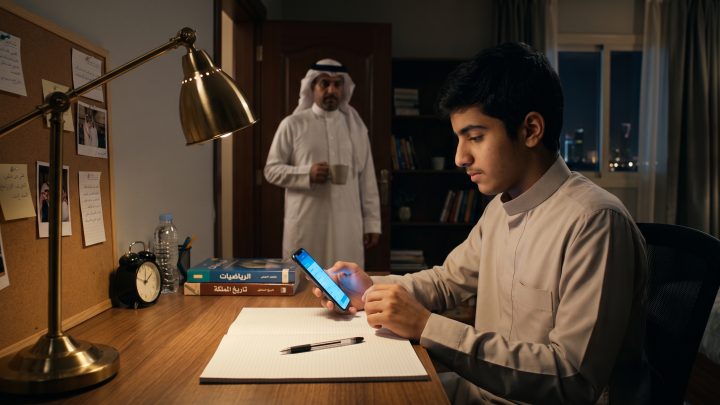
A mother borrows her son’s phone to photograph something, and an app appears in front of her, open on a long conversation. She reads two lines and then pulls back, because the conversation is not about a school assignment. It is about a bad day at school, and a friend who changed, and a feeling she has not heard from him in months.
When artificial intelligence and children are mentioned, the discussion goes straight to cheating on homework. That is a legitimate worry, but it is not the most important thing happening.
More important is that a number of our children are not using these tools to solve an assignment, but to express their private feelings.
What the Numbers Reveal
The 2026 report from the British communications regulator Ofcom states: one in every ten children who use artificial intelligence use it as someone to talk to or as a friend.
And in the Common Sense Media survey conducted in March 2026 on 1,204 children between the ages of nine and seventeen, it emerged that 86% of them use artificial intelligence, and that among the users, 37% discuss their feelings or personal problems with it and 40% practice conversations and social skills with it.
When asked whom they ask first about a health-related matter, 73% said they ask a trusted adult, but 12% said they ask a chatbot first, and the figure rises to 27% among daily users.
The Number Every Student Counselor Should Read
The 2025 report from the British organization Internet Matters produced the most serious finding in this whole area.
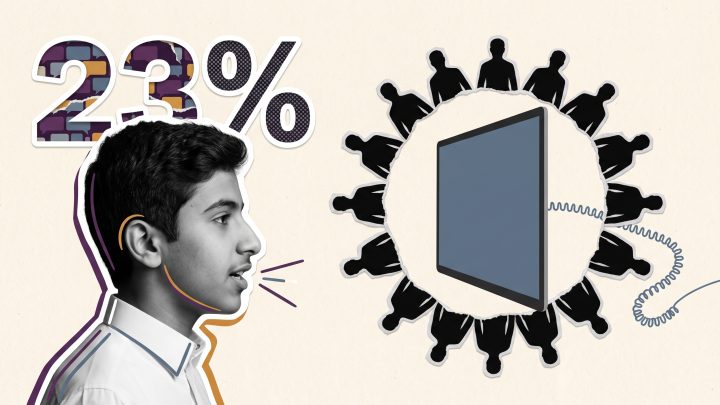
17 percent of the most vulnerable children use companion bots, compared with 6% of other children — close to three times as many. 50% of them say that talking to artificial intelligence is like talking to a friend, compared with 35% in the sample overall. And 23% of them say outright that there is no one else they talk to, compared with 12% in the sample overall.
Read those lines again: the child who replaces the student counselor with a bot is the child most in need of the student counselor.
This is not a technology issue. It is a student counseling issue, first and foremost.
Why This Age in Particular
Between twelve and fourteen, a large part of an adolescent’s identity is formed, and how his peers see him becomes heavier than at any time before. And at this stage in particular, the bot offers him three things that are hard to find in his surroundings.
It does not judge him, so he can say what he would be embarrassed to say to a friend who might pass it on tomorrow. It does not get bored, so it is available at three in the morning with no signs of impatience. And it does not tell anyone — which is precisely both the advantage and the problem.
Where Exactly the Problem Lies
First, it does not disagree. A conversation designed to keep the user engaged tends toward agreement. The adolescent who needs someone to tell him “I think you’re wrong here” mostly hears an echo of his own opinion.
Second, it does not know the context. It knows nothing of his family, his school, or his history.
Third, it cannot act. It does not call anyone, it does not protect, and it does not get the case to someone who has the power to intervene.
Fourth, the disclosure goes nowhere. In the same survey, 17% of chatbot users encountered something inappropriate for their age, and 53% of them did not tell any adult.
Addition or Replacement
Between ordinary use and use that calls for concern there is one difference, observable from inside the home: has the bot been added to his circle, or has it taken its place?
The adolescent who asks the tool about an idea and then discusses it with his friend is adding to his circle. But the one who used to talk to his brother or his friend or his teacher and then stopped, so that all his talking now happens in a single window — that is replacement.
The practical indicator is not the time counter; it is the number of human beings he talked to this week about something that mattered to him.
What Not to Do
He is not to be mocked; a single sentence along the lines of “you’re talking to a program?” is enough to close the subject for good.
He is not to be banned abruptly, because an abrupt ban moves the use to another device or another account and puts an end to the parent’s knowledge of what is going on.
And the worst is not to be assumed, because using artificial intelligence at this age is common behavior, not an indicator of crisis in itself.
So What Should Be Done
Ask him an open question rather than an interrogative one: what do you use it for most? That is far more useful than: do you talk to it about your problems?
Then sit with him for ten minutes in front of the app, try it yourself, and ask him what he thinks of its answer. That alone turns the tool from a secret into a shared subject.
And teach him to verify: put together a question the two of you know the answer to, ask the tool to answer it, then discuss what it got wrong. A lesson drawn from a mistake you both saw lasts longer than any warning.
And agree with him on one red line: everything to do with the body, with health, and with heavy feelings gets discussed with a human being. This is not a ban on the tool; it is an ordering of priorities.
The most important thing remains that you be the easier option. The numbers say that children still prefer the trusted adult, provided he is available and does not pass judgment. The competition here is not with the technology; it is with how easy you are to reach.
Three Signals for the Student Counselor
A student who addresses the tool the way people are addressed and describes it as understanding him. A student who knows details with no human source and does not mention having asked anyone. And social withdrawal coinciding with a rise in time spent using it.
The question that opens the door is not: do you use artificial intelligence? It is: when you need to talk to someone, who is the first person who comes to mind? The answer to that question reveals far more.
The tool is not an adversary, and banning is not a strategy. But if your child’s closest listener becomes a program that does not know him and cannot protect him, the problem is not in the program; it is in the space we left empty.