“My Son Is the Bully”: The Guide Nobody Writes

The call usually comes in the middle of the day, in a calm voice from the school and a polite sentence: I’d like to speak with you about something that happened today.
On the way home the parent thinks about ten things at once. Is this true? Who told the story? What will people say? And how do I face my son?
If you search in Arabic for “school bullying” you will find dozens of articles, and nearly all of them are written for the victim’s parents. But every incident has two sides, which means there is another family sitting up that night and finding not a single line written for them.
First: Read the Numbers Carefully
The local press has circulated figures attributed to the General Authority for Statistics indicating that repeated bullying in schools did not exceed 2%, and that 81.80% of the 8–14 age group and 86.15% of the 15–19 group were not exposed to any form of bullying over twelve months.
Reading these numbers requires attention. The 2% figure concerns repeated bullying alone. The proportion exposed to any bullying over the year is the complement of the second figure, meaning roughly 18% in the 8–14 group. Both numbers are correct, but settling for the first gives the impression that the problem is marginal, and it is not, at this age in particular.
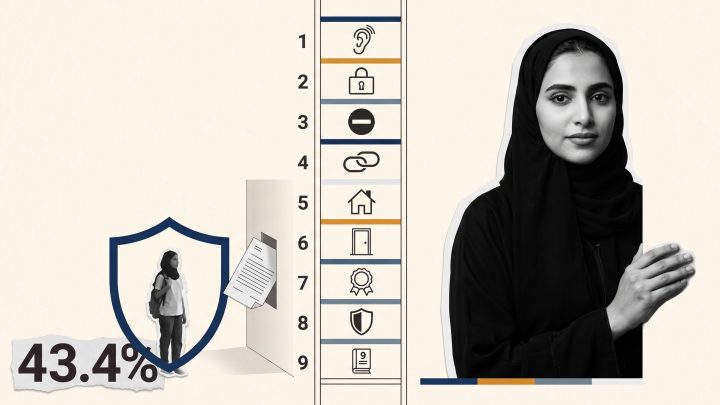
To this is added a third figure from a Saudi study published in 2026 on adolescents between eleven and seventeen: 43.4% of them would not tell the school if they were subjected to cyberbullying. What this means is that what reaches the school administration is far less than what actually occurs, and that by the time a report arrives, the matter has already recurred several times.
The Four Mistakes of the First Hour
The first is denial: my son doesn’t do this, and they’re the ones who started it. It is an understandable reaction, but it ends the investigation before it begins and puts the school in the position of an adversary.
The second is the eruption. Immediate harsh punishment ends the conversation and teaches a child one lesson — not to get caught next time — which is the exact opposite of what is intended.
The third is justification: this is how boys are at this age. It is partly true, but it prevents a child from seeing the effect of his action on another person, which is precisely what we want him to see.
The fourth is generalizing to the child: you are a bad boy. A child who is defined by his behavior takes it on, and the description always falls on the act: “this behavior is harmful,” not “you are harmful.”
Why Children Do It in the First Place
At this age in particular, pure cruelty is rarely the motive.
The motive may be status, since the group at this age is built in a hierarchy and mocking someone is a fast route upward. It may be an imitation of a behavior a child sees at home or in content he follows and reproduces without grasping its effect. It may be a response from a child who has himself been bullied somewhere else, a common case that needs an entirely different handling. And it may be a weakness in reading emotions, so that he does not see the effect of his words on the other person’s face and takes it for joking.
Knowing the motive is not a justification; it is what determines the remedy. The child seeking status needs a legitimate route to it, and the child who was a victim needs protection himself.
The First Conversation
Begin after you have calmed down rather than in the moment itself, and keep it short:
I heard from the school, and I want to hear it from you — listening first, all the way to the end.
I don’t want to know who started it, I want to know what happened — this cuts off the argument about who began it.
Do you know how the other child felt? — one question, then waiting for the answer however long the silence lasts.
This behavior is harmful, and it will not happen again — a clear limit, without shouting.
And now let’s talk about how we fix it — a move from holding to account to repairing.
Repair, Not a Formal Apology
An apology imposed in front of everyone rarely repairs anything, and often only increases the humiliation of both sides.
Repair is more useful: that your child do something tangible to make up for the harm — return what he damaged, or write an apology in his own handwriting delivered without an audience, or commit to a specific behavior at break that the teacher follows for two weeks.
The standard in choosing the repair is that it be connected to the harm, not a general punishment such as being banned from playing for a week. An unconnected punishment makes a child forget the victim and occupies him with his own grievance.
If the Bullying Is Online
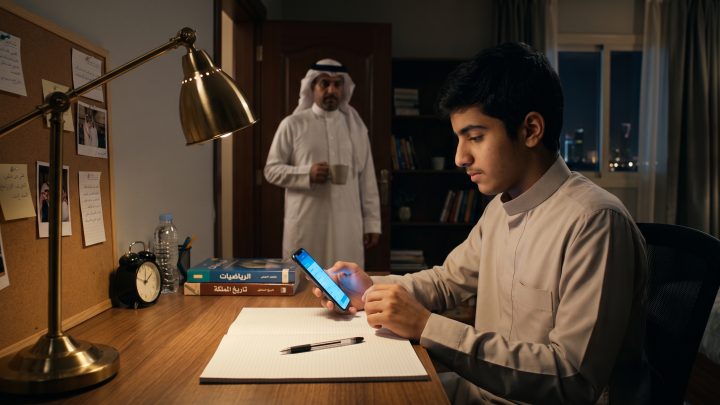
Two things change. The first is that the effect does not end when the school day ends; the message stays, gets forwarded, and is read by others. The second is that your child may not see what he did as bullying at all, because he did not see the other person’s face while reading it.
So let this be the axis of the conversation: ask him to read aloud what he wrote, in front of you. The sentence that is written easily on a screen is hard to say to a person’s face, and that very difference is what explains the behavior and repairs it.
With the School: A Partner, Not an Adversary
The Ministry of Education addresses bullying within the Conduct and Attendance Rules, and it has the Rifq program, preventive and remedial, for reducing school violence in all its forms.
Ask the student counselor three specific questions: what exactly was observed? Is this the first time or is there a history? And what is the agreed plan for the next four weeks?
A family that comes in with these questions moves from the position of an accused party defending itself to the position of a partner working on a remedy, and that alone changes the course of the case.
When to Seek Specialist Support
If the behavior recurs despite the intervention, or is accompanied by cruelty to animals or to younger siblings, or comes with withdrawal or persistent sadness, or it emerges that your child is himself being harmed somewhere else, then this is not a matter for home upbringing alone. Speak to the student counselor and request specialist support. And in cases of harm inside the family or outside it, the domestic violence and child protection reporting line 1919 is available around the clock.
The good news is that bullying behavior at this age is changeable to a great extent, provided it is faced early and calmly, and without losing the child along the way.