Signs That Your Child Has Become Dependent on Artificial Intelligence
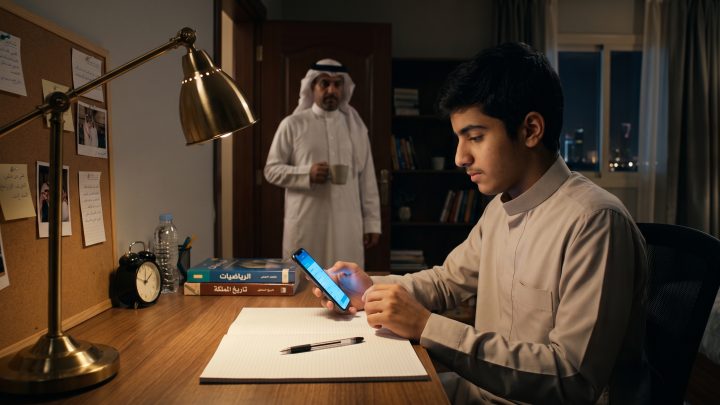
The page in front of him is blank and the question is clear, but he does not begin. He opens the app first, copies the question, waits for the answer, and then begins.
And that moment, the moment of beginning, is where the attention belongs — not the number of times he uses the tool.
The question parents usually ask is: does my child use artificial intelligence? The answer is all but settled: 86% of children and adolescents between nine and seventeen use it, and the figure rises to 92% in the 16–17 group, according to the Common Sense Media survey conducted in March 2026.
The more useful question is a different one: has he become dependent on it? And that question has a measurable answer.
Dependence Has a Signature
In the same survey, 29% of children showed at least one indicator of dependence, and the figure rises to 52% among daily users.
In detail: 20% said that stopping for a month would be difficult, and the figure rises to 42% among daily users. And 16% of those who use it for homework find it difficult to start or finish the work without it, rising to 28% among those who use it daily for homework.
In the RAND Corporation survey published in March 2026 on 1,214 young people between twelve and twenty-nine, the use of artificial intelligence for homework rose from 48% in May 2025 to 62% in December 2025 — in seven months and no more — with the growth driven by intermediate and secondary students in particular.
What is striking is that the students themselves see the problem: 67% of them agree that heavy use of artificial intelligence in study will harm critical thinking, an increase of more than ten percentage points in ten months.
The Dividing Line: Who Did the Thinking
The most useful framework RAND came out with is not permitted and forbidden; it is the distinction between two states.
The first is cognitive offloading: artificial intelligence performing the mental work on the student’s behalf — writing, solving, summarizing — while the student copies.
The second is cognitive augmentation: enabling the student to do deeper mental work than he would have reached on his own — explaining a difficult concept to him, arguing against his position, generating exam questions he answers himself.
The tool here is the same one, and the difference is in who did the thinking. That is the criterion that should govern the discussion at home.
Six Specific Signs
The first is that he does not begin without it, opening the tool before he has even read the question.
The second is that he cannot explain what he submitted. Ask him to explain a paragraph of his assignment in his own words; this is the most precise test there is.
The third is a disproportionate reaction when it is unavailable — agitation beyond anything a broken tool would justify.
The fourth is the use widening into personal decisions, moving from the assignment to what he says to his friend and how he replies to a message.
The fifth is the disappearance of drafts: there is no more crossed-out paper and no first attempt, and the answers arrive final and complete.
The sixth is a decline in exams alongside steady homework grades. This is the clearest of them all: the work done at home is excellent and the classroom exam looks nothing like it.
The First Conversation
In the survey, 44% of children had not had a single conversation with either parent about the safety of artificial intelligence. What this means is that in your home, most likely, this conversation has not yet happened.
So begin it from curiosity rather than accusation.
“Show me how you use it” — and sit with him for ten minutes. What you come away with from those minutes outweighs any ban.
“What does it do better than you, and what are you better at than it?” — a question that gets him evaluating the tool instead of consuming it.
“Mind if I ask it a question I know the answer to, and we see what it says?” — then discuss the mistake when it comes. A lesson drawn from a mistake you both saw lasts longer than twenty warnings.
Three Mistakes Parents Make
The first is searching for evidence. Reading the chat history looking for proof of cheating ends the trust without ending the use, and a second account is all it takes for everything to disappear from your view.
The second is counting every use as cheating. The student who asked the tool to explain a lesson he did not understand did something entirely legitimate. Equating this with copying the answer costs you your credibility in drawing distinctions, so he stops listening to you in both cases.
The third is settling for one conversation. These tools change every couple of months, and the use expands with academic pressure. Let it be a short recurring conversation rather than a single speech.
Five Household Rules
That the original material be read before the tool is opened. That everything submitted be explained out loud. That every number and name be verified, because the tool phrases what it does not know with confidence. And that personal and health matters be discussed with a human being.
As for the fifth, it is the most useful: one week in the term without the tool. This is not a punishment but a measurement — a week in which your child learns, and you learn, where he actually stands without it. And his reaction to the mere suggestion of the idea is information in itself.
As for Banning
It is not a realistic option for a seventeen-year-old who will enter a university and a job market that uses these tools daily.
The alternative is competence: knowing how it works, where it goes wrong, and when to verify. UNESCO has issued an AI competency framework for students and another for teachers, both available in Arabic, and they are a good reference for any family or school wanting to build this skill in an orderly way rather than improvising.
The goal is not a child who does not use the tool, but a child who can work without it if he needs to — and that is a difference that shows up in the exam hall before it shows up anywhere else.