Only Nine Percent: How to Build a Reading Home Before Your Child Starts School
Picture a home with a four-year-old in it, and toys, and a tablet, and a large screen, and a mother who talks to him all day and sings with him. A warm home by every measure.
So how many books are in it?
That exact question is what makes the Early Childhood Development and Child Wellbeing Statistics Bulletin, issued by the General Authority for Statistics in 2025, worth pausing on, because it brings together two numbers that deserve to be read side by side.
The first is reassuring: 90% of children between 36 and 59 months live in a stimulating home learning environment, and 82.4% of children between 24 and 59 months are on the right developmental track according to the ECDI2030 index.
The second is far less reassuring: only 9.2% of those children have three or more children’s books at home, and 31% have one or two.
There is not necessarily a contradiction between the two numbers, but the tension between them raises a question: what is it that we are counting as stimulation?
What Makes These Three Years Decisive
Between the ages of three and five, a child’s vocabulary expands at a pace that is not repeated at any later stage. And the difference between one child and another at this age does not show up in the ability to read, since neither of them reads yet; it shows up in the number of words they have heard in a meaningful context.
This is why the effect of the home appears late. In first grade the gap does not look large. By fourth grade it becomes the difference between a child who understands the science text and a child who decodes its letters without understanding it.
A third number in the same report adds to the weight of this: only 17.3% of children between 36 and 59 months are enrolled in early childhood programs, with the figure rising to 73% at age five. What this means is that most of our children spend the pre-school years at home rather than in kindergarten. The home is the classroom at this stage, whether we like it or not.
A Book the Child Cannot See Does Not Exist
A child at this age does not read what his eye never falls on, and a book on a high shelf in the guest room is entirely outside his world.
The number of books within his reach, then, is not educational decoration; it is the likelihood of chance encounter: how many times a day his eye might land on a book so that he reaches for it without anyone asking him to.
Hence the first step is bringing the books down to his height, onto a low shelf or into a basket in the corner of the living room. It does not matter whether they are tidy. The only standard is that the child can take a book without having to ask for help.
The Language of Reading at Home
This is a question that belongs to us, and translated books do not answer it. The most practical approach is to read the text as it is in simplified Standard Arabic, then explain in colloquial Arabic when needed, without translating the whole book into dialect and without insisting on a heavy Standard Arabic that leaves the child losing the thread. A child’s ear needs to hear Standard Arabic early in order to grow familiar with it, and his mind needs to follow the story. Both are possible at once: the sentence in Standard Arabic, the explanation in the language of the home.
Reading Is a Conversation, Not a Recitation
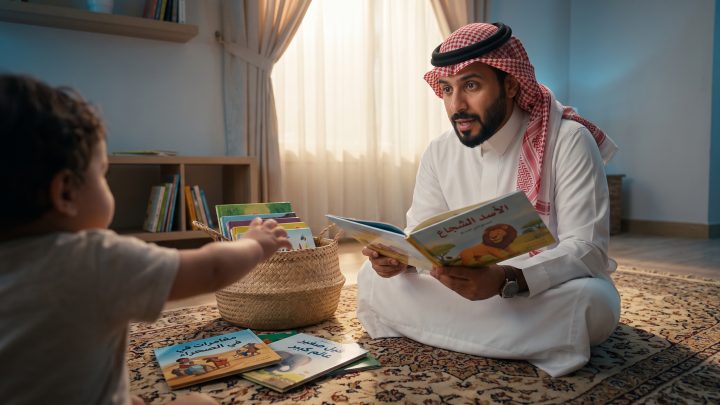
This is the most important habit that can be built at this age. Do not read the page and then turn it; stop and ask: so what do you expect to happen now? And why did he get angry? And did you see something red in the picture? The difference between the two approaches is the difference between a child who listens and a child who thinks.
Let your child go back to the same book twenty times. The boredom here is the adult’s boredom, not the child’s. Repetition at this age is a mechanism for mastery: with every reading the child picks up a new layer, the word, then the intonation, then a detail in the picture he had not seen before.
And three books at home is a very close target as soon as we drop the condition that they be owned. Public libraries, school libraries, and digital subscriptions all serve the purpose, and variety here matters more than ownership.
How to Choose a Book
There are three quick standards that are useful while a parent is standing in front of the shelf. The first is the number of words on the page: a line or two for a three-year-old, four or five for a five-year-old. The second is a picture that tells the story; if the story can be told from the pictures alone, the book suits this age. The third is rhythm, because repetition, rhyme, and the sentence that returns on every page are not primitive. They are what makes a child join in the reading before he knows the letters.
When a Child Refuses
Refusal at this age is usually a refusal of the sitting, not of the book. Before concluding that your child “does not like reading,” try three adjustments: read him two pages and stop while he is at the peak of his interest; let him turn the pages himself even if the order is wrong; and sit beside him rather than facing him.
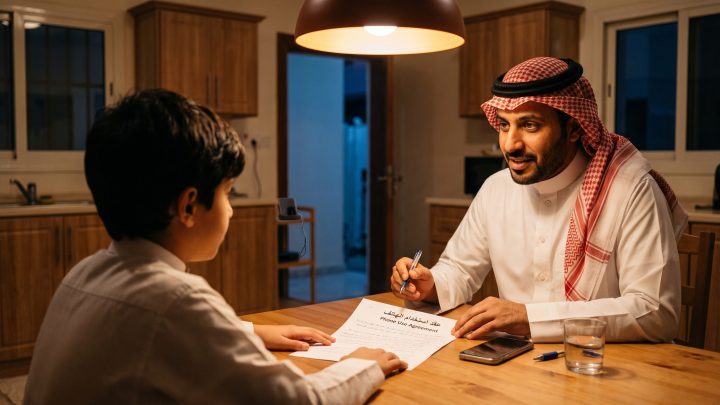
To these a fourth factor is added, one that is often overlooked: that the father read too. A child who sees reading as a women’s activity in the home rules himself out of it early, and boys are more prone to this.
When to Read
The time that works is the time that requires no decision. If reading is tied to something that happens every day anyway, such as after brushing teeth or right before the light goes out, it becomes part of the sequence rather than one more item in an exhausting day.
And if there is more than one child at home, read to all of them even if their ages differ. The younger one picks up the rhythm, and the older one explains to his brother and in doing so consolidates his own understanding.
A Final Caution
Reading must not turn into an obligation with a schedule, a reward, and points. The aim at this stage is not for your child to learn to read early; it is for him to associate books with warmth, with closeness, and with his father’s voice. The child who loved books will learn to read in his own time, and with the child who learned to read early and came to hate books, we have lost more than we gained.
Nothing separates your home from leaving the 9.2% but three books.