Career Guidance When the First Rung Disappears

At every family gathering, the high school student is asked the same question: what will you study? The expected answer is a major, and the social esteem follows from which major it is.
That question made sense when the path was clear: a major, then an entry-level job, then a gradual climb.
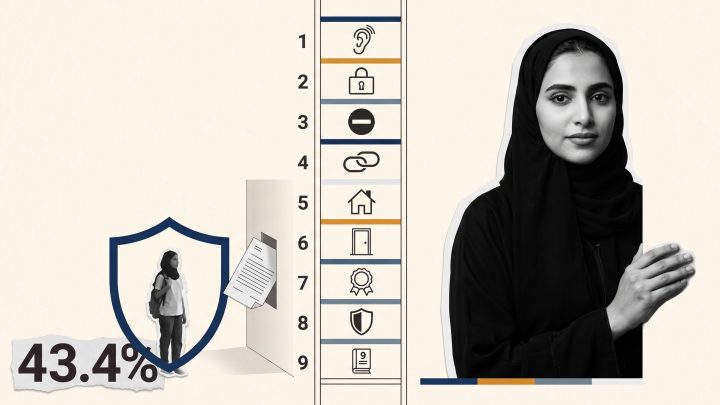
The problem is that the first rung on this ladder is precisely what has begun to erode.
What Is Happening
In an article published in MIT Technology Review in May 2026 titled “It’s Time to Address the Looming Entry-Level Jobs Crisis,” a direct diagnosis is put forward: that the tasks traditionally assigned to a new employee — summarizing, initial drafting, sorting, preliminary research, and transcription — are the first things artificial intelligence systems do well.
The result is not necessarily the disappearance of the profession, but the disappearance of the entry point to it. The engineer, the accountant, the lawyer, and the designer are all still in demand, but the first year in which a graduate used to learn by doing is shrinking. What that means is that a graduate is now required to arrive having already learned part of what used to be learned on the job.
And What Does This Mean for a Saudi Adolescent Today
First: that choosing a major is no longer a single decisive decision. It has become one of two decisions, the second being: what will I have accumulated in experience and evidence before I graduate?
Second: that “the safe major” is a concept whose reliability has declined. Safety today lies closer to a set of capabilities that transfer across fields than to the name of any one major.
Third: that working with artificial intelligence as a colleague has become a basic competency rather than an added advantage, in the way that office computing did two decades ago.
Five Capabilities That Hold Up
The first is judging quality. The tool produces quickly, and the value has moved to distinguishing the good from the poor and judging what is produced.
The second is framing the question. Whoever knows how to define the problem comes ahead of whoever knows how to carry out the solution.
The third is human communication: persuading, negotiating, managing disagreement, and reading a room — about as far from automation as it gets.
The fourth is fast self-directed learning, meaning the ability to master a new tool or field within weeks.
The fifth is reliability: keeping to deadlines and finishing what is started. It is the simplest thing on the list and, in practice, the rarest in the labor market.
As for Concrete Evidence
Talk about capabilities stays theoretical unless it turns into something tangible, and a high school student has three realistic forms available.
The first is real published work: a project, a simple app, a report, or a design — anything that can be opened and seen, its size mattering less than its existing at all.
The second is a short period of field experience: two weeks in an office, a clinic, a workshop, or the family store. The value is not in the task but in seeing how people actually work.
The third is recurring responsibility: running an activity, training a younger team, or a weekly commitment kept for six months. This is the one that proves reliability, and it cannot be claimed.
All of this intersects with the Human Capability Development Program under Vision 2030, which is built on developing the citizen’s capabilities to compete globally. What that means is that what we are asking of our children here is not an individual effort; it runs with the national direction itself.
Paths Few People Notice
Family discussion usually revolves around a limited number of university majors, and there are other paths, established and in demand.
Among them is the technical and applied path: colleges and institutes that graduate students with a directly employable skill, many of whose specializations are hard to automate because they combine the hand with judgment — specialized maintenance, industrial operations, and health technologies.
Among them are short professional certificates: in accounting, cybersecurity, data analysis, and project management, built in parallel with studying and producing tangible evidence before graduation.
Among them is early freelance work: design, programming, translation, and video editing. The value here is not the income, but that a student deals with a real client and a real deadline at seventeen.
And among them is small-scale entrepreneurship: a limited project even if it does not last, since what remains of it is the skill and the story, and both get asked about in every later interview.
There is no steering the student away from university in this. It is that the university major should not be the only thing he owns on the day he graduates.
Four Questions to Replace “What Will You Study?”
What do you work on and lose track of time? — reveals the real inclination rather than the declared one.
Who do you know who works in this field, and can we talk to him? — twenty minutes with a practitioner is worth twenty articles.
What is the smallest thing you could do this month to try out this field? — moves the discussion from imagining to trying.
And if this path doesn’t work out, what is the second path? — teaches him to think in alternatives, a skill he will need more than any major.
And a fifth question is added a year from now: has your view changed? And why? The adolescent who is allowed to change his mind after an experience learns that a career decision is a path to be reviewed rather than a verdict pronounced once. The one who feels that his choice at seventeen binds him forever will hold on to a wrong choice for years, for no reason other than that he announced it in front of people.
An Important Caution
Do not transfer your anxiety to him. The adolescent who hears that the jobs will disappear does not prepare; he freezes or withdraws.
The right message is calmer and more precise: that the path has changed shape, no more than that, and that whoever builds real capabilities and tangible evidence that he can do the work will find his place.
The only role required of you is to make experimenting possible and inexpensive: that he tries, that he gets it wrong, and that he changes his mind at seventeen rather than at twenty-five.