The Impact of Children’s Toys on Teaching Them Self-Expression
How can children’s toys be more than just a means of entertainment? In fact, children’s play is not just fun and games; it is a powerful educational tool that helps young ones express themselves in different ways. Through play, a child learns how to share their feelings, voice their thoughts, and interact with the world around them in a natural and seamless manner. Parents’ awareness of these dimensions makes them more conscious of the importance of choosing children’s toys that foster emotional and social communication skills in their kids, rather than letting it be just a passing activity to fill free time.
Why Are Children’s Toys Considered a Means of Self-Expression?
Children’s toys represent a world of their own, offering the child an opportunity to use their imagination and emotions in various situations. When a child holds a certain toy or engages in role-playing, they reflect what they feel deep inside without the need for complex words.
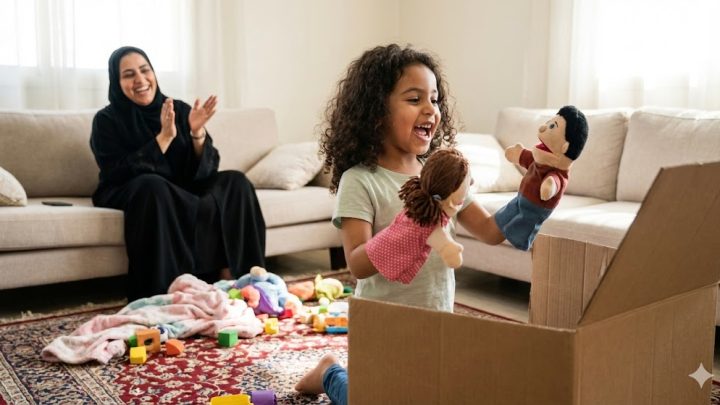
Moreover, play helps them translate what they cannot express linguistically into behaviors or actions that those around them can understand. For example, a child might use small puppets or dolls to act out a scene expressing their fear or joy. This is where the value of children’s toys lies, as they offer parents a window to understand what is going on in their little one’s mind. It is a natural way for emotional release and self-expression, making it an essential tool for sound psychological and social personal growth.
How Do Children’s Toys Help Develop Emotional Skills?
Play is not just a time for fun; it is a safe space where a child learns how to deal with their emotions. When they use children’s toys in imaginary scenarios, they begin to understand what it means to be angry, happy, or even frustrated. This awareness of emotions constitutes the first step toward emotional intelligence.
A child might use a toy to build a tower and then get angry when it falls; here, they learn how to handle frustration in a healthy way. Furthermore, parents’ participation in play helps the child label and understand their feelings more clearly. Consequently, children’s toys act as a practical tool to train the young child in emotional expression and emotional regulation in a natural and simple manner, enhancing their psychological well-being.
Children’s Toys and Their Role in Developing Social Communication Skills
Through children’s toys, a child learns the basics of communicating with others. Group play teaches them how to share, wait for their turn, and listen to their friends’ opinions. These small experiences form the foundation of their future social skills.
When children cooperate in building blocks or a group game, they develop the capacity for dialogue and negotiation. Additionally, children’s toys allow them to experience hypothetical social scenarios, such as role-playing a teacher or a doctor, which enhances their understanding of societal roles. Parents who encourage this type of play help their children become more aware of the rules of social interaction and more capable of expressing themselves in their relationships with others.
Imagination and Creativity: Free Expression Through Children’s Toys
Children’s toys are not just physical tools; they are platforms for imagination and creativity. When a child builds an entire world using dolls or blocks, they express their thoughts and feelings in innovative ways. This free space grants them the ability to shape stories and narratives, thereby expressing themselves without boundaries.
Imagination here serves as training for creative thinking and problem-solving. For instance, when a child uses empty boxes to transform them into cars or houses, they express their inner world in a creative way, supporting their personal growth. Toys that encourage creativity give the child a unique opportunity to discover themselves and communicate with others in a different language—the language of imagination.
Interactive Toys as a Bridge to Expressing Suppressed Emotions
Often, a child finds it difficult to voice their feelings in words, especially if they are experiencing stress or fear. This is where the importance of interactive toys, such as puppets or role-playing games, comes in, as they allow them to express their suppressed emotions indirectly.
A child might express their school anxiety through a doll character that talks about the same fear. This type of play does not only contribute to entertainment but also functions as a therapeutic tool that helps parents understand the challenges their little one is facing. Thus, interactive games become a psychological bridge that enables the child to express themselves with greater freedom, away from direct pressures or fear of punishment, nurturing their mental well-being.
The Role of Educational Toys in Enhancing Verbal Expression
Educational toys, such as picture cards or language games, give the child an opportunity to use words in a fun way. Through these games, they begin to learn the names of objects, describe colors, and express simple events.
This process is reflected in their ability to express themselves verbally with greater clarity. Children’s educational toys are not limited to entertainment; they are an effective means of developing language and communication. When parents participate in these games, they help the child expand their vocabulary and boost their confidence in using words. Thus, educational toys become a pedagogical tool that helps build a solid foundation for communication and expression.
How Do Children’s Toys Reveal Your Child’s Personality?
Through the way a child plays, parents can discover the traits of their personality. Children who prefer group games may be more social, while those drawn to individual games may lean toward contemplation and independence.
Children’s toys also reveal their way of thinking; a child who loves assembling blocks may tend toward logical thinking, while one who prefers drawing and dolls may be more creative. Observing play offers parents a chance to understand their little one’s temperament on a deeper level, helping them guide them in a way that suits their personality. In this manner, children’s toys serve as an honest mirror revealing the child’s inclinations and inner motives.
Choosing the Right Children’s Toys to Support Self-Expression
Not all toys achieve the same goals, so it is important for parents to be careful when choosing children’s toys. Toys that encourage interaction and imagination, such as blocks or role-playing games, help express thoughts and emotions.
Meanwhile, electronic games, if used in moderation, might enhance some skills, but they do not replace real-life connection. Therefore, parents must consider the child’s age and interests when choosing a toy, ensuring it is suitable for developing their psychological and social skills. Providing the right children’s toys does not mean spending large sums of money, but rather choosing what aligns with the child’s needs to express themselves honestly and freely.
Tips for Parents to Use Children’s Toys in Positive Parenting
Parents can benefit from children’s toys as an educational tool if they utilize them effectively. The most important tips include:
Active Participation in Play: The child feels safe and supported when their parents interact with them.
Asking Open-Ended Questions: It is recommended to ask simple questions during play that help the child express what they are thinking.
Avoiding Total Control: It is crucial to avoid taking full control of the play, letting the child lead so they can express themselves with greater freedom.
Observing Reactions: Finally, parents should observe their child’s reactions during play, as they reveal a great deal about their feelings.
In this way, children’s toys turn into an effective educational medium, contributing to building a strong personality capable of self-expression.
Ultimately, children’s toys remain an honest mirror that reveals the depths of their personalities and feelings. They are an educational medium that grants the child a safe space to experiment, make mistakes, and learn how to express themselves freely. The more parents focus on providing the appropriate children’s toys, the more they help their children achieve healthy psychological development, building trust in their abilities to express themselves and communicate, thereby promoting their psychological resilience and holistic wellbeing.