Handwriting Is Not an Old Habit
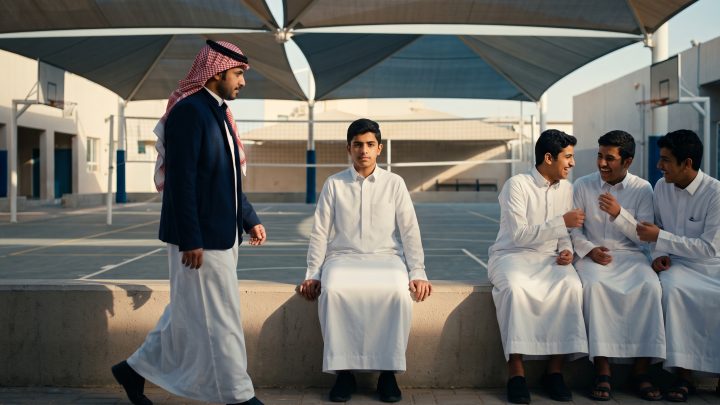
In the staff room there is a discussion that repeats every term. One teacher says her students’ hands can no longer manage a full page. Another replies that what is needed today is other skills and that penmanship has become a luxury. A third asks the only question worth answering: do we have evidence, or is each of us defending her own generation?
The evidence exists, and it does not say precisely what either side expects.
What the Instruments Recorded
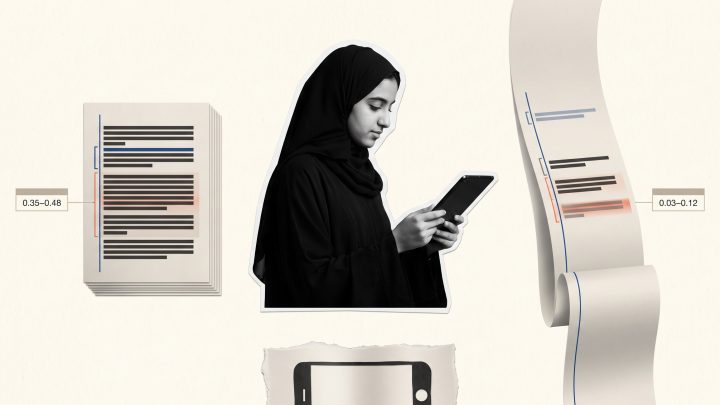
In a study published in the journal Frontiers in Psychology in 2024, researchers Van der Weel and Van der Meer recorded the brain’s electrical activity at high density during handwriting and during typing on a keyboard. The finding that gave educational circles pause was that the patterns of connectivity in the brain during handwriting were far more widespread than during typing, showing up in the theta and alpha frequencies associated with memory formation and learning.
The likeliest explanation is simple and convincing. When a child writes a letter by hand he carries out a different movement for each letter — path, pressure, direction, and connection. When he types, the finger movement is nearly the same for all the letters; the position changes, not the action.
The handwritten letter leaves a motor trace attached to its shape. The typed letter leaves nothing worth mentioning.
In 2025, an experimental study published in the Journal of Experimental Child Psychology on children’s learning of letters and words concluded that handwriting training outperformed typing training.
And let this be said clearly before more is built on it than it can bear: these are studies of limited size, and their effect sizes are modest rather than revolutionary. What they support is a division of roles, not a declaration of war on the keyboard.
As for Arabic Script
This is a space that belongs to us, and it has not yet been studied.
Arabic script is connected, and the shape of the letter changes as its position in the word changes — initial, medial, final, and isolated. What this means is that an Arab child does not learn twenty-eight shapes but several times that number, each shape with a different motor path.
If the motor trace is what fixes a letter in memory, as the studies suggest, then theoretically the effect in Arabic should be larger rather than smaller. But this is a reasonable hypothesis, not a proven finding, and not enough research has been done on it yet. It is at the same time one of the clearest research gaps facing Arab educators today.
Where the Keyboard Wins
So that the above is not read in an extreme way: there are places where typing clearly wins.
Among them are long texts that get reviewed and revised, because a draft that will be reworked three times, if written by hand, will have consumed the student’s time in copying rather than in thinking. Among them is the case of students whose penmanship is hindered by a motor difficulty, because when forming the letter drains all of the student’s attention, nothing is left over for the content, and the keyboard here frees the idea from the burden of the hand. Among them is collaborative work, since a document four students write in together cannot be done on paper. And among them is anything submitted for formal assessment, because clarity of text in front of the marker is in the student’s interest.
The rule, then, is not that paper is better, but: the hand when we are learning, the device when we are producing.
Dividing the Roles in the Classroom
Everything learned for the first time — a new letter, a term, a spelling rule — is written by hand. Everything produced in volume and needing review and revision is written on a device.
The keyboard is not to be abolished. A student who cannot type well will pay the price at every later stage. What is called for is a sequence, not an exclusion.
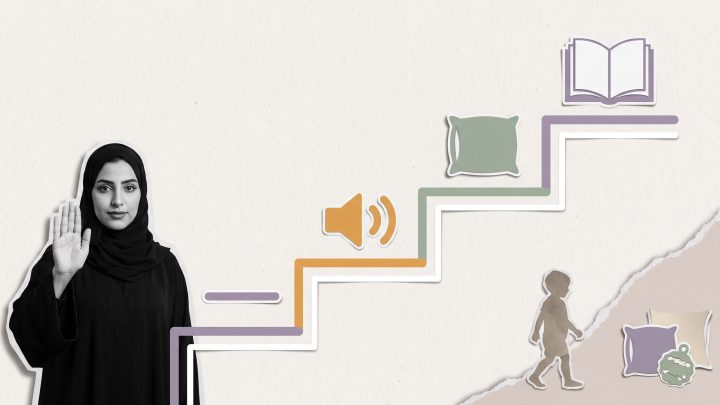
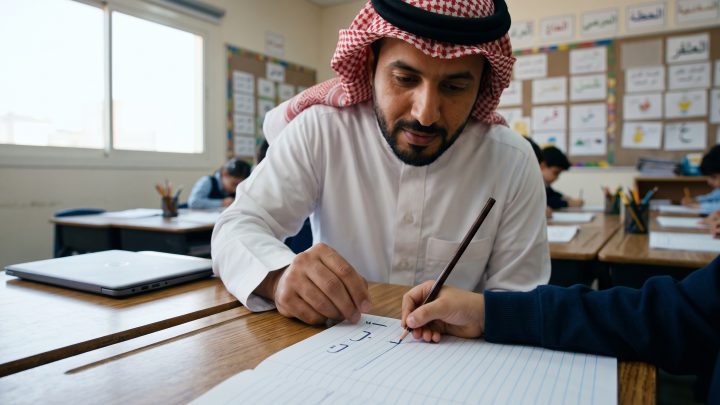
A new letter is to be written, not merely colored in, because coloring inside a letter is a fine motor activity but it does not give the letter’s path. Instead, tracing with the finger, then with the pen, then free writing, in that order.
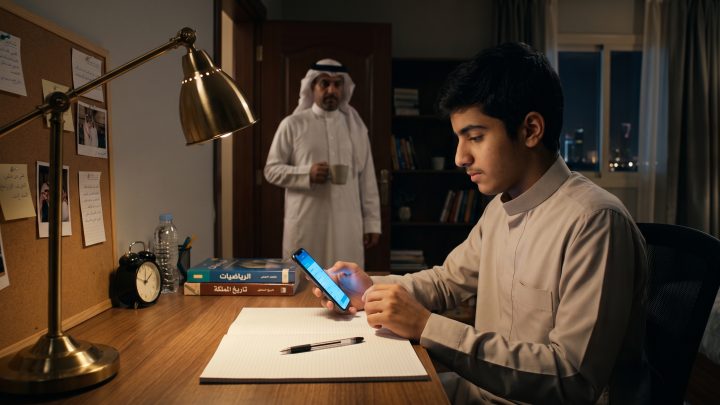
And even in the digital classroom, let the key points be noted down on paper. Writing is slower than typing, and that very slowness is what obliges the student to select and to phrase rather than copy word for word.
Three Common Mistakes
The first is starting with beauty before the path. What is required in the early grades is that the letter be written in the right direction and from the right starting point, not that it be beautiful. A letter drawn in the wrong order looks fine on the page while having lost its entire motor trace.
The second is an excess of mechanical copying. A page filled in without attention is not equal to five lines a student writes while thinking about what he is writing.
The third is neglecting posture: the height of the desk, the way the pen is held, the tilt of the page. These are details that look secondary, and they are the first thing to tire a child’s hand, so that he comes to hate writing before he has mastered it.
And the most important of them all remains that a student not be punished with writing. A teacher saying “write the sentence twenty times” turns the tool into a penalty and creates a student who hates picking up a pen, which is the fastest route to losing everything above.
How We Know the Approach Is Bearing Fruit
By a simple indicator that needs no measurement instrument: recall after a week. Ask the student to write the new term seven days later without going back to his notebook. The difference between what he remembers of what he wrote by hand and what he remembers of what he typed will show up immediately, and it is more convincing to a teacher and to her colleague in the staff room than any foreign study.
What We Tell Parents
A short message is enough: ask your children to write by hand whatever they are learning for the first time, even for five minutes a day. There is no need for penmanship workbooks or extra hours, because five minutes of deliberate writing is more useful than a full page filled in without attention.
As for beautiful penmanship, it is a pleasant secondary gain. The main gain is that a child remembers what he wrote with his hand more than he remembers what he pressed with his finger.