Circadian Rhythm and Light: How to Sync Your Biological Clock From Your Desk

You sit at 3:00 PM under the bright white fluorescent lights of your office, feeling a heavy drowsiness in your eyelids and a fog in your focus. Then you return home at night to check your phone under bright lighting, only to be surprised that your sleepiness completely vanishes the moment you lie in bed.
The issue lies not merely in your ability to sleep, but in the contradictory signals your biological clock receives every day: a dim daytime within office walls, and a night illuminated by screens and overhead lamps.
📌 Wellbeing Disclaimer:
This article is intended for lifestyle awareness and the timing of light exposure, and does not provide medical treatment for chronic insomnia or clinical sleep disorders. If sleep difficulties directly impact your daily performance and overall health, please consult a specialized physician.
How Does Light Direct Your Biological Clock?
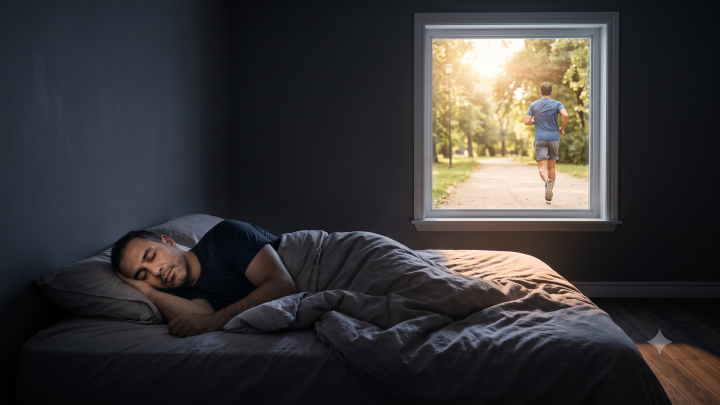
Your body treats light as the primary cue for telling time. Bright light in the morning sends a crucial signal to the brain to boost vitality and elevate alertness, while darkness in the evening prepares the body to release hormones that encourage relaxation and sleep.
When you spend your daytime in a dim office and flood your evening with artificial lighting, this natural rhythm becomes disrupted. The result is not merely temporary fatigue, but a decline in sleep quality and daytime energy.
What Do the Latest Large-Scale Studies Say?
In a large prospective observational study published in PNAS (2024), researchers tracked light exposure patterns among nearly $89,000$ participants from the UK Biobank using wrist-worn sensors for a week, following their health indicators for approximately eight years.
The findings demonstrated a clear correlation: participants exposed to more daylight and less night light recorded better health indicators and a lower overall mortality risk. The study shows that circadian disruption resulting from light exposure at inappropriate times is associated with reduced overall health levels.
(A Crucial Note: Remember that this study is observational; it reflects a strong statistical correlation but does not, on its own, prove direct causation.)
The Impact of Natural Light in the Workplace
Another exploratory study published in the Journal of Clinical Sleep Medicine compared $49$ office workers, some of whom worked near windows receiving natural light, while others worked in windowless or distant spaces.
Results indicated that employees working near windows received $173%$ more natural white light during work hours and slept an average of $46text{ minutes}$ longer each night compared to their colleagues, recording higher scores on vitality and sleep quality metrics.
The researchers noted that the effect of natural light coming from side windows significantly fades beyond $6$ to $8text{ meters}$. Your physical distance from the light source makes a practical difference.
Three Light Windows to Sync Your Day
10 Morning Minutes Before 9:00 AM: This is the single most important window to calibrate your clock. Step out onto a balcony, take a short walk to your car, or pause near the building entrance. Outdoor light in the morning—even on overcast days—is exponentially more effective than the strongest indoor lighting.
Daytime Light Breaks: Sit near a window if your office layout permits. If your workstation is far away, take your lunch break or make phone calls in an area with natural light.
Dimming Lights One Hour Before Bed: Turn off bright overhead lights and rely on a dim side lamp, while lowering screen brightness. The goal is to send a clear signal to your brain that the night has begun.
What This Cannot Resolve
Optimizing light exposure provides a positive signal to your biological clock, but it does not eliminate direct structural hurdles:
Architectural designs in windowless offices or mandatory seating arrangements are beyond your control.
Night shift work forces a rhythm that requires specialized arrangements under expert supervision.
Family obligations and evening pressures may delay your bedtime despite your best efforts.
The objective is not to attain a flawless environment, but to capitalize on available opportunities for natural light exposure without self-blame over circumstances beyond your control.
🎯 Weekly Exercise: Over the next five days, step outside for $10text{ minutes}$ under natural light before 9:00 AM, and record in your phone notes how your energy level feels at 3:00 PM.
Conclusion
Your biological clock responds to the intensity and timing of light, not to the hands on a clock. Giving your body natural daylight in the morning and reducing evening lighting gradually restores your energy and sleep balance. Consistency with simple daily steps makes the biggest impact over the long run.
🌙 Tonight’s Action Step: Turn off bright overhead room lights an hour before bedtime, relying only on a dim side lamp to signal relaxation to your brain.