AI Reliance in Learning

You might ask an AI tool to summarize a complex forty-page report, and it delivers neat bullet points within seconds. You skim through the summary feeling complete comprehension. However, in the next day’s meeting, when your manager asks for your opinion on the recommendations, you stumble, finding nothing firmly anchored in your mind.
The problem lies not in the tool, but in an age-old cognitive fallacy: feeling that understanding is effortless is one thing, while locking knowledge into your mind is something entirely different.
What Is Cognitive Offloading and How Does It Deceive You?
Cognitive offloading is the delegation of a mental task to an external tool. Pens and calculators are excellent offloading tools that relieve your brain from memorization and simple procedural operations.
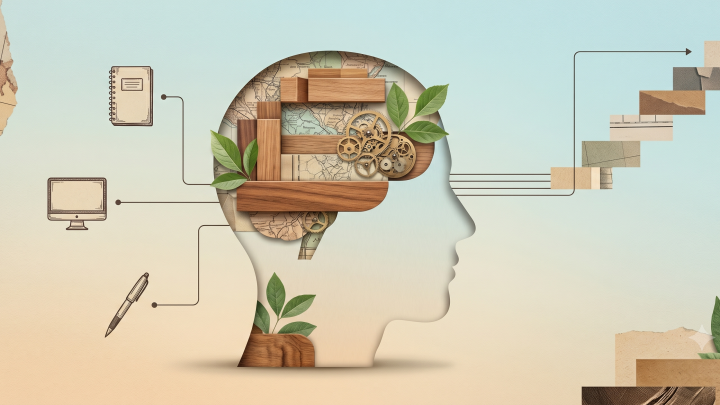
However, the difference with generative AI tools is that they do not offload auxiliary operations; rather, they offload the very step where learning actually occurs: formulating understanding by yourself. When you assign the tool the task of condensing, connecting, and inferring, your brain experiences the pleasure of passive viewing without building new neural pathways.
What Do Field Studies Say?
Correlation with Critical Thinking: In a survey study encompassing 666 participants and published in the journal Societies (2025), researchers found a negative correlation between the intensity of AI tool usage and levels of critical thinking, with cognitive offloading acting as a mediating factor.
Self-Confidence vs. Tool Confidence: Another study from Microsoft Research and Carnegie Mellon University (presented at the CHI 2025 conference) surveyed 319 knowledge workers. Results demonstrated that high confidence in the tool reduced the exercise of critical thinking, whereas employees who trusted their self-efficacy rigorously reviewed outputs and maintained their critical thinking skills.
(A Crucial Note: It is essential to remember that these two studies are correlational and rely on self-reports; they observe recurring behavior but do not prove direct causation.)
Easy Understanding Is an Illusion of Memory
Consolidating knowledge requires effort and active retrieval. In a landmark experiment published in the journal Science (2011), the group of students who practiced “retrieving information from memory” outperformed the group that relied on “rereading and creating concept maps.”
The ultimate paradox was that the participants’ predictions were inverted: those who read the smooth concept maps expected to have mastered the material but failed the test, whereas those who engaged in challenging retrieval achieved the highest scores. The smoothness offered by an AI tool is precisely this illusion: effortless reading is misidentified by your brain as mastery.
The Three-Step Protocol to Control Learning
Do not stop using the tool; instead, rebuild the learning step through this protocol:
Use the tool: Request a summary, draft, or initial explanation to accelerate the start.
Close and write from memory: Close the screen completely, and write on a side sheet of paper or in your phone notes three points you understood in your own words without looking back at the text. These five minutes are the true source of learning.
Compare and bridge the gaps: Reopen the tool’s text and compare what you wrote with what you forgot. The gaps you discover are what will solidify in your long-term memory.
When to Speed Up Your Work and When You Lose Your Skills
The Direct Executive Rule: Offload what you do not need to master, and retain what you are evaluated on.
Use the tool for basic literacy in a secondary field outside your specialization (such as formatting tables or translating basic terminology). However, if the task demands your professional judgment or formulating a stance expected specifically from you, write your first draft yourself before soliciting the tool’s input.
What This Cannot Resolve
Regulating your interaction with AI enhances your individual efficiency, but it does not eliminate structural and organizational hurdles:
Demands from management for doubled productivity and tight deadlines may force you into total reliance on the tool.
The absence of organizational training programs leaves teams struggling between outright rejection and blind adoption.
The goal is not to abandon technology or slow down your workflow, but to safeguard your intellectual ownership of your profession so you do not find yourself helpless when questioned without a screen.
🎯 Weekly Exercise: The next time you ask AI to explain a concept or draft an idea, rewrite the answer in two sentences in your own personal style in your phone notes before transferring it to your report.
Conclusion
Artificial intelligence does not replace our minds; rather, it exposes the illusions of fast learning. Effortless reading gives you a false sense of mastery, whereas active retrieval is what builds genuine expertise. Using the tool mindfully saves your time while sharpening your skills.
🌙 Tonight’s Action Step: Open the last answer you received from AI, close the screen, and write down in your phone notes three key points you comprehended without looking at it again.