

The Hard Equation of Middle Managers
Balancing Leadership Demands, Employee Needs, and Organizational Expectations
Executive Summary
This report focuses on managers and middle managers as a central part of the wellbeing equation. Managers shape how employees experience work every day: they communicate priorities, manage workload, give feedback, handle conflict, create trust, and notice signs of stress or disengagement. For many employees, the quality of work is strongly shaped by the quality of management.
The report argues that organizations cannot expect managers to protect employee wellbeing without supporting managers themselves. Middle managers occupy a demanding position between senior leadership and employees. They are expected to deliver goals, maintain morale, support teams, manage change, and respond to concerns, often with limited authority over budgets, staffing, timelines, or wider organizational decisions. This creates a gap between responsibility and control, which can lead to stress, emotional exhaustion, role overload, and burnout.
Global evidence shows that manager wellbeing is a growing concern. Gallup’s 2026 State of the Global Workplace shows that manager engagement fell from 31% in 2022 to 22% in 2025, with the sharpest recent drop taking place between 2024 and 2025. Other data shows that manager-level employees report higher burnout than entry-level employees, and managers are more likely to consider leaving their roles. A regional case study from Morocco also shows that middle manager burnout can appear through physical exhaustion, mental rumination, intellectual fatigue, concentration difficulties, and emotional depletion, often linked to workload, lack of recognition, role ambiguity, repetitive tasks, and poor work-life balance.
The report identifies managers as wellbeing gatekeepers. They influence daily contact, emotional climate, workload, boundaries, recognition, meaning, trust, psychological safety, fairness, and inclusion. Their behavior can make work feel clearer, fairer, and more supportive, or more stressful and uncertain. At the same time, the report recognizes that managers do not control every factor affecting wellbeing. Staffing levels, senior leadership decisions, organizational culture, salaries, and workload demands can limit what managers are able to do.
The report also highlights the hidden pressure carried by middle managers. They often absorb employee frustration, communicate difficult decisions, manage conflict, balance operational and people responsibilities, and support employees during pressure or change. Much of this emotional and coordination work is invisible, yet it directly affects both manager wellbeing and employee experience. When managers are supported, they are more likely to communicate clearly, respond with patience, make fair decisions, and create a healthier team climate. When they are overloaded or burned out, they may become less available, more reactive, and less able to support employees effectively.
To improve manager wellbeing, the report recommends action at several levels. Senior leadership should treat manager wellbeing as a business priority, reduce conflicting priorities, review whether managers have enough authority and resources, and recognize people-management quality. HR and People teams should provide manager-specific wellbeing training, confidential support pathways, coaching, peer circles, and data on team wellbeing. Middle managers should set clearer expectations, hold regular wellbeing check-ins, know when to refer employees to professional support, protect recovery time where possible, and ask for support early.
Overall, the report presents manager wellbeing as a practical lever for healthier teams and stronger organizational performance. Supporting managers is not separate from supporting employees. It is one of the clearest ways organizations can turn wellbeing from a policy into daily workplace practice.
Introduction
Employee wellbeing is no longer a peripheral concern for organizations. It has become closely linked to performance, retention, engagement, productivity, and the overall quality of workplace culture. In Saudi Arabia, where organizations are changing at a fast pace and expectations around talent, leadership, and organizational performance continue to grow, wellbeing has become part of how employers think about sustainable success.
Within this conversation, managers and middle managers hold a central position. They are often the closest representatives of the organization in employees’ daily work lives. They shape how priorities are communicated, how workloads are managed, how feedback is given, and how supported employees feel during pressure, change, or uncertainty. For many employees, the experience of work is strongly shaped by the experience of being managed.
Middle managers, in particular, occupy a demanding position. They are expected to deliver senior leadership priorities, maintain team morale, manage performance, solve operational problems, and respond to employee concerns. Yet they may have limited control over budgets, staffing, timelines, or wider organizational decisions. This creates a difficult gap between responsibility and authority: middle managers are often held accountable for employee experience without always having the resources needed to improve it.
This matters because many wellbeing strategies focus mainly on employees as individuals: offering counselling, awareness campaigns, workshops, or benefits. These services are valuable, but they are incomplete if the daily work environment remains unchanged. Managers are the people who translate policies, values, and wellbeing commitments into everyday practice. If managers are unsupported, overloaded, or unclear about their role, even well-intentioned wellbeing initiatives may fail to reach employees in a meaningful way.
This report focuses on managers and middle managers as both influencers of employee wellbeing and individuals with their own wellbeing needs. It argues that organizations cannot expect managers to support healthy teams without also supporting managers themselves. Strengthening manager wellbeing, capability, and organizational support is one of the most practical ways to build healthier workplaces and more sustainable performance.
Statistics on Manager Wellbeing
Available global data shows that managers are becoming a higher-risk group for stress, burnout, and disengagement. Gallup’s 2026 State of the Global Workplace links much of the recent decline in engagement to managers: manager engagement dropped from 31% in 2022 to 22% in 2025, including a five-point decline from 27% in 2024 to 22% in 2025. In best-practice organizations, however, 79% of managers were engaged, nearly four times the global average, showing that manager wellbeing and engagement are not fixed outcomes, but can improve when organizations invest in better management systems.
Global figures
- Manager engagement globally fell to 22% in 2025, down from 31% in 2022.
- The sharpest recent fall in manager engagement happened from 2024 to 2025, dropping from 27% to 22%.
- In best-practice organizations, 79% of managers were engaged, compared with the 22% global average.
- Managers are 24% more likely to consider quitting within six months, according to meQuilibrium data reported by HR Dive.
- Manager-level employees reported higher burnout than entry-level employees, at 54% compared with 40% according to NAMI.
Case Study: Burnout Among Moroccan Middle Managers
A 2025 Moroccan study, Between Pressure and Performance: A Study of Burnout Profiles among Moroccan Middle Managers, provides a useful regional case for this report. The study focused on middle managers in Moroccan private-sector companies and used a mixed approach combining life-narrative interviews with psychometric questionnaires.
In the Moroccan study, 47.6% of participating managers showed relatively high burnout, with 63.49% reporting physical exhaustion, 61.05% reporting persistent mental rumination, 45.10% reporting intellectual fatigue, 36.46% reporting concentration difficulties, and 31.91% reporting emotional depletion.
The Moroccan study found that middle manager burnout was linked to work overload, lack of recognition, role ambiguity, repetitive tasks, and poor work-life balance.
The Manager as a Wellbeing Gatekeeper
Managers play a direct role in shaping the daily experience of work. Policies, benefits, and wellbeing programs may be created at the organizational level, but employees often experience them through their direct manager. The manager is usually the person who explains priorities, distributes work, responds to pressure, gives feedback, handles conflict, and notices whether an employee is struggling. For this reason, managers can either protect employee wellbeing or unintentionally increase stress.
This does not mean that managers alone are responsible for wellbeing. Many factors sit beyond their control, including staffing levels, organizational culture, salaries, workload demands, and senior leadership decisions. Yet managers remain a key link between the organization and the employee. Their behavior can make work feel clearer, fairer, and more supportive, or more stressful, uncertain, and emotionally draining.
Daily Contact and Emotional Climate
The relationship between employees and their direct manager is one of the most consistent influences on workplace wellbeing. Through daily conversations, meetings, feedback, tone, and availability, managers shape whether employees feel respected, heard, and valued. A manager who listens, responds calmly, and treats employees with dignity can create a sense of emotional safety within the team.
Small behaviors matter. The way a manager reacts to mistakes, asks about workload, communicates pressure, or acknowledges effort can affect how employees feel throughout the working day. Employees are more likely to feel supported when their manager is approachable, fair, and emotionally steady. By contrast, dismissive communication, unpredictable reactions, or constant criticism can make employees feel anxious, defensive, or disconnected from their work.
Workload, Priorities, and Boundaries
Managers often act as the first line of workload management. They influence how tasks are distributed, how urgent requests are handled, how deadlines are communicated, and how priorities are clarified. When managers set realistic expectations and help employees distinguish between urgent and less urgent tasks, they reduce confusion and pressure.
Boundaries are also a key part of wellbeing. In many workplaces, employees struggle not only because they have too much work, but because expectations are unclear and everything feels urgent. Managers can help by protecting focused work time, discouraging unnecessary after-hours communication, reviewing workload regularly, and being realistic about what can be achieved with available resources.
At the same time, managers may face pressure from above that limits their ability to protect employees fully. This makes organizational support necessary. A manager cannot maintain healthy workloads if the wider organization rewards overwork, sends conflicting priorities, or treats constant availability as normal.
Recognition and Meaning
Recognition is one of the simplest ways managers can support wellbeing. Employees need to feel that their effort is seen and that their contribution matters. Recognition does not have to be formal or expensive. It can be as simple as thanking someone for a specific piece of work, acknowledging improvement, giving credit publicly, or explaining how an employee’s work contributes to a larger goal.
Managers also help employees find meaning in their roles. Many tasks can feel routine or stressful when they are disconnected from purpose. A good manager helps employees see how their work supports the team, the organization, clients, patients, customers, or the wider community. This connection between daily effort and meaningful contribution can strengthen motivation and reduce feelings of emptiness or disengagement.
Trust and Psychological Safety
Trust is central to workplace wellbeing. Employees are more likely to raise concerns, ask for help, admit mistakes, and speak honestly about stress when they believe their manager will respond without blame or humiliation. This is what makes psychological safety important: it allows employees to be honest without fearing punishment or embarrassment.
A psychologically safe team does not mean a team without standards. It means that high expectations are paired with respect, clarity, and support. Managers can build this kind of environment by listening before judging, responding constructively to mistakes, inviting input, and treating concerns seriously. When employees feel safe to speak, problems can be addressed earlier, before they become crises.
Without trust, employees may hide stress, avoid difficult conversations, or pretend that everything is manageable. Over time, this can lead to burnout, disengagement, conflict, or turnover. For this reason, the manager’s reaction to vulnerability is often more important than any formal wellbeing message from the organization.
Fairness and Inclusion
Fairness strongly affects how employees experience work. Employees notice how opportunities are distributed, how workloads are assigned, how feedback is given, and how decisions about promotion, flexibility, and development are made. When employees feel that decisions are inconsistent or biased, wellbeing suffers. Feelings of unfairness can create frustration, resentment, and loss of trust.
Managers influence fairness through everyday decisions. They can support a healthier team climate by being transparent about expectations, applying standards consistently, explaining decisions where possible, and checking whether work is being distributed in a balanced way. Fairness also means recognizing different needs without creating a sense of favoritism.
Inclusion is closely connected to fairness. Employees are more likely to feel well at work when they feel respected, involved, and able to contribute. Managers help create this by inviting different voices into discussions, preventing exclusionary behavior, giving equal access to development, and making sure that quieter employees are not overlooked.
Taken together, daily contact, workload management, recognition, trust, and fairness show why managers are wellbeing gatekeepers. They do not control every factor that affects employee wellbeing, but they have strong influence over the daily conditions in which employees work. Supporting managers to lead in these areas is one of the clearest ways organizations can turn wellbeing from a policy into a lived experience.
The Hidden Pressure on Middle Managers
Middle managers play one of the most demanding roles in the organization. They are close enough to employees to carry the emotional weight of daily workplace challenges, yet close enough to senior leadership to be held accountable for goals, targets, and execution. This position gives them influence, but it can also expose them to pressure from both directions.
Caught Between Senior Leadership and Employees
Middle managers often stand between two different sets of expectations. Senior leaders expect them to deliver organizational goals, meet deadlines, implement change, and keep teams productive. Employees expect them to listen, support, explain decisions, solve problems, and protect the team from unreasonable pressure.
This creates a difficult balancing act. A middle manager may personally understand employee concerns, but still be required to implement decisions made at a higher level. They may be asked to maintain motivation during restructuring, budget limits, increased workload, or shifting priorities. In these moments, the manager becomes the person who must communicate pressure in a way that does not damage morale.
This role can become emotionally exhausting. Middle managers may feel responsible for keeping employees engaged, even when they do not fully agree with the decisions they are asked to deliver. They may need to defend organizational priorities upward and employee concerns downward, often without full clarity or full control. Over time, this can create stress, frustration, and a sense of being pulled in two directions.
High Responsibility, Limited Authority
One of the greatest pressures on middle managers is the gap between what they are accountable for and what they can actually control. They may be responsible for team performance, employee satisfaction, productivity, and retention, but may have limited authority over staffing, budgets, compensation, policies, timelines, or strategic decisions.
This gap can place managers in an unfair position. They are expected to solve problems that are partly structural. For example, a manager may be asked to reduce burnout in a team that is understaffed, improve morale during a period of uncertainty, or retain employees without being able to influence pay, promotion pathways, or workload levels.
When responsibility is not matched with authority, managers can feel powerless. They may know what their team needs but lack the tools to act. This can lead to repeated frustration: listening to employee concerns, escalating them, waiting for decisions, and returning to the team without a meaningful solution. Over time, this weakens the manager’s confidence and can affect how employees perceive their support.
Supporting middle managers means giving them more than accountability. It means giving them realistic decision-making space, clear priorities, access to resources, and senior leadership backing when difficult trade-offs need to be made.
Emotional Labor
Middle managers carry a large amount of emotional labor. They are often the first person employees approach with stress, conflict, frustration, personal difficulties, or concerns about workload and fairness. They may need to calm tensions, listen to complaints, respond to anxiety, and manage difficult conversations without showing their own stress.
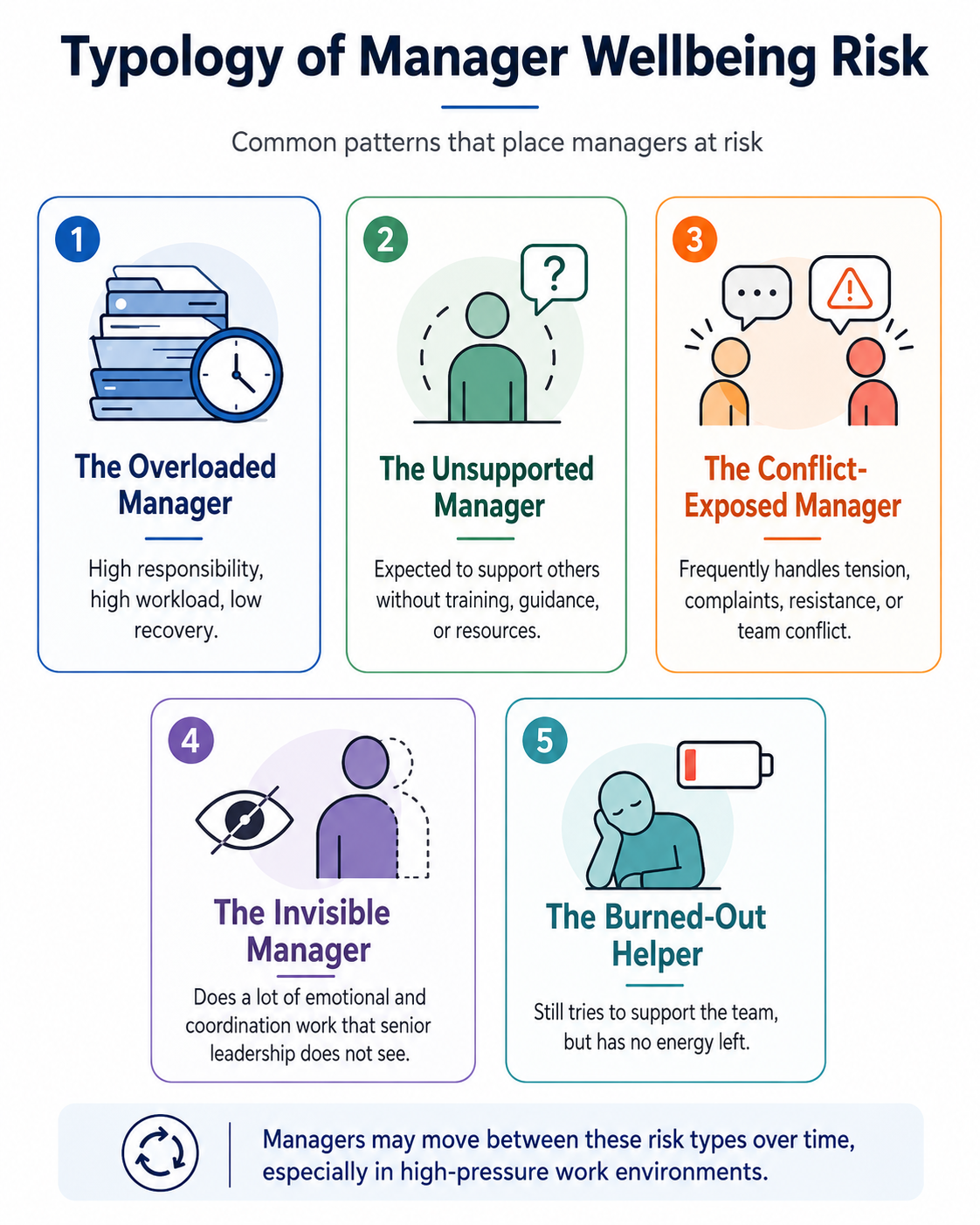
This emotional labor is often invisible. It may not appear in job descriptions, performance reviews, or productivity metrics, yet it takes time and energy. A manager may spend hours supporting an employee through a difficult period, mediating a conflict, or helping the team process change. This work is valuable, but it can be draining.
Managers may also absorb emotions that they cannot fully resolve. They may hear employee concerns about unfairness, pressure, or uncertainty, but have limited ability to change the root causes. This can create emotional strain, especially for managers who care deeply about their teams.
Without proper support, emotional labor can lead to exhaustion, detachment, irritability, or avoidance. Some managers may become less available to their teams, not because they do not care, but because they no longer have the emotional capacity to keep absorbing stress. This is why manager wellbeing is directly connected to the quality of support employees receive.
Role Overload
Middle managers often carry several roles at once. They are expected to manage people, deliver operational work, track performance, attend meetings, report to senior leadership, implement strategy, resolve conflict, support employee wellbeing, and respond to urgent issues. In many organizations, people management is added on top of their existing workload rather than treated as a role that requires dedicated time.
This creates role overload. Managers may move from one task to another without enough space to think, plan, reflect, or recover. They may spend the day in meetings, handle employee concerns between tasks, complete their own work after hours, and still feel they are falling behind.
Role overload can reduce the quality of management. When managers are stretched, they may become reactive rather than supportive. They may delay feedback conversations, skip check-ins, communicate less clearly, or focus only on urgent tasks. This can affect employees, who may interpret the manager’s lack of availability as disinterest or poor leadership.
The problem is not always individual time management. In many cases, the role itself has become too wide. Organizations need to recognize that good management requires time. If managers are expected to support wellbeing, coach employees, build trust, and maintain team culture, then their workload must leave room for that work to happen.
Lack of Support for Managers
Organizations often expect managers to support employee wellbeing, but do not always prepare them for this responsibility. Many managers are promoted because they are technically strong or reliable performers, yet they may receive limited training in people management, emotional support, conflict resolution, burnout prevention, or difficult conversations.
This leaves managers exposed. They may know that an employee is struggling but feel unsure how to respond. They may worry about saying the wrong thing, crossing professional boundaries, or mishandling sensitive information. They may also struggle with their own stress but feel that asking for help would make them appear weak or incapable.
Support for managers should include practical skills and personal support. They need training on how to recognize signs of distress, hold supportive conversations, refer employees to professional services, manage workload discussions, and create psychologically safe team environments. They also need spaces where they can discuss their own challenges confidentially, receive coaching, and access wellbeing support without stigma.
Manager support should not be limited to one-time training. It should be part of the organization’s operating model. Middle managers need regular guidance, clear escalation pathways, peer support, senior leadership alignment, and access to tools that help them lead well without sacrificing their own health.
The pressure on middle managers is often hidden because they are expected to appear capable, composed, and in control. Yet if organizations ignore this pressure, they risk weakening the very group they rely on to deliver performance and protect employee wellbeing. Supporting middle managers is not an extra benefit. It is a practical requirement for healthier teams, stronger leadership, and more sustainable organizational performance.
Manager Wellbeing and Employee Outcomes
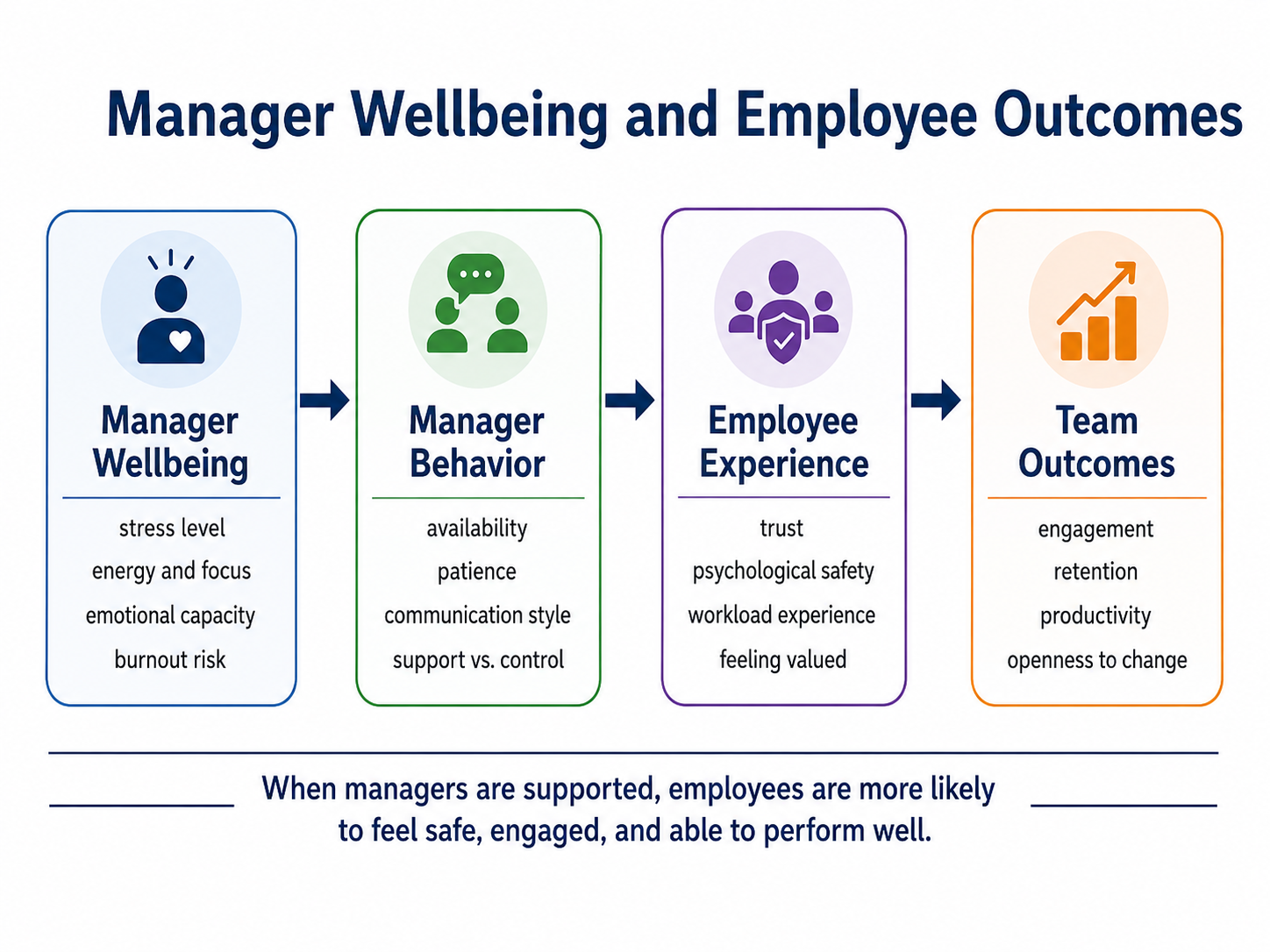
Manager wellbeing directly shapes employee experience. Supported managers are more likely to communicate clearly, respond with patience, make fair decisions, and create a team climate where employees feel safe, valued, and able to perform. When managers are under pressure or burned out, they may become less available, more reactive, and more controlling, which can weaken trust and increase stress across the team. For this reason, investing in manager wellbeing can improve engagement, retention, productivity, and openness to change.
What Employees Need From Managers
Employees need managers who make daily work feel clear, fair, and manageable. The most common needs include:
- Clear communication: Employees need to know what is expected, what matters most, and how decisions affect their work.
- Respectful treatment: Employees need to feel treated with dignity, especially during pressure, feedback, or disagreement.
- Realistic workload: Employees need managers to assign work in a way that matches time, capacity, and available resources.
- Appreciation: Employees need their effort to be noticed, especially when they are handling pressure or going beyond basic expectations.
- Flexibility: Employees need reasonable flexibility that helps them manage work demands and personal responsibilities.
- Fairness: Employees need consistent standards in workload, opportunities, feedback, recognition, and decision-making.
- Growth conversations: Employees need managers who discuss development, strengths, goals, and future opportunities.
- Emotional support: Employees need managers who listen, notice signs of strain, and respond with care rather than judgment.
- Space to raise concerns: Employees need to feel safe speaking about workload, stress, conflict, or unclear expectations.
- Practical help: Employees need managers who do more than motivate. They need help removing barriers, clarifying priorities, and connecting them to support.
What Managers Need From Organizations
Managers need organizations that give them the clarity, resources, and support required to lead well. The most common needs include:
- Clear priorities from senior leadership: Managers need to know what matters most, where trade-offs can be made, and how to align their teams with wider goals.
- Realistic targets: Managers need goals that match available time, staffing, budgets, and capacity.
- Training in people management and wellbeing: Managers need practical skills for feedback, conflict, workload conversations, burnout prevention, and employee support.
- Access to HR and mental health support: Managers need clear pathways for guidance when an employee is struggling or when a situation goes beyond their role.
- Peer support groups for managers: Managers need safe spaces to share challenges, learn from others, and reduce the isolation of the role.
- Coaching: Managers need one-to-one support to strengthen confidence, decision-making, communication, and self-management.
- Authority that matches responsibility: Managers need enough decision-making space to act on the problems they are expected to solve.
- Time to manage people, not only tasks: Managers need protected time for check-ins, feedback, planning, team support, and follow-up.
- Recognition for good people management: Managers need to be valued for building healthy teams, not only for meeting operational targets.
- Data on team wellbeing: Managers need simple, timely insights on stress, engagement, workload, and support needs so they can respond early.
Typology of Manager Wellbeing Risk
Recommendations
Improving manager wellbeing requires action at several levels. Senior leaders, HR and People teams, and middle managers each have a role in creating healthier teams and reducing the pressure carried by managers.
For Senior Leadership
- Treat manager wellbeing as a business priority: Manager wellbeing should be seen as part of performance, retention, and organizational stability, not as a personal issue for managers to handle alone.
- Review authority, time, and resources: Leaders should assess whether managers have the decision-making space, staffing, tools, and time needed to support their teams effectively.
- Include people-management quality in performance reviews: Managers should be recognized for how they lead people, not only for operational results.
- Reduce conflicting priorities: Senior leadership should give managers clearer direction, fewer mixed messages, and more realistic expectations.
- Model healthy boundaries from the top: Leaders set the tone for work culture. When they respect recovery time, communicate clearly, and avoid normalizing overwork, managers are more likely to do the same with their teams.
For HR and People Teams
- Provide manager-specific wellbeing training: Managers need practical training on burnout, workload conversations, psychological safety, difficult conversations, and employee support.
- Create confidential support pathways for managers: Managers should know where to go when they need guidance on sensitive employee situations or their own wellbeing.
- Offer coaching or peer circles: Coaching and peer support can help managers reflect, solve problems, and feel less isolated in their role.
- Track manager stress and team wellbeing together: HR teams should measure manager pressure alongside employee wellbeing, workload, engagement, and retention indicators.
- Support managers during high-pressure periods: Managers need extra support after restructures, organizational change, major deadlines, or periods of uncertainty.
For Middle Managers
- Set clearer team expectations: Managers can reduce stress by clarifying priorities, deadlines, responsibilities, and what success looks like.
- Hold regular wellbeing check-ins: Short, consistent check-ins help managers notice pressure early and respond before issues grow.
- Know when to refer employees to professional support: Managers should listen and support, but they should not be expected to act as therapists or solve personal mental health challenges alone.
- Protect recovery time where possible: Managers should model healthier boundaries by managing after-hours communication, taking breaks, and encouraging realistic working patterns.
- Ask for support early: Managers should raise concerns with senior leadership, HR, or professional support channels before pressure becomes unmanageable.
References
https://www.gallup.com/workplace/697904/state-of-the-global-workplace-global-data.aspx
https://ibimapublishing.com/articles/IBIMABR/2025/804127/
Some of the report's findings:
- 22%Manager engagement globally fell to 22% in 2025
- 54%Manager-level employees reported higher burnout than entry-level employees, at 54% compared with 40
- 47.6%High Burnout Among 47.6% of Moroccan Middle Managers

